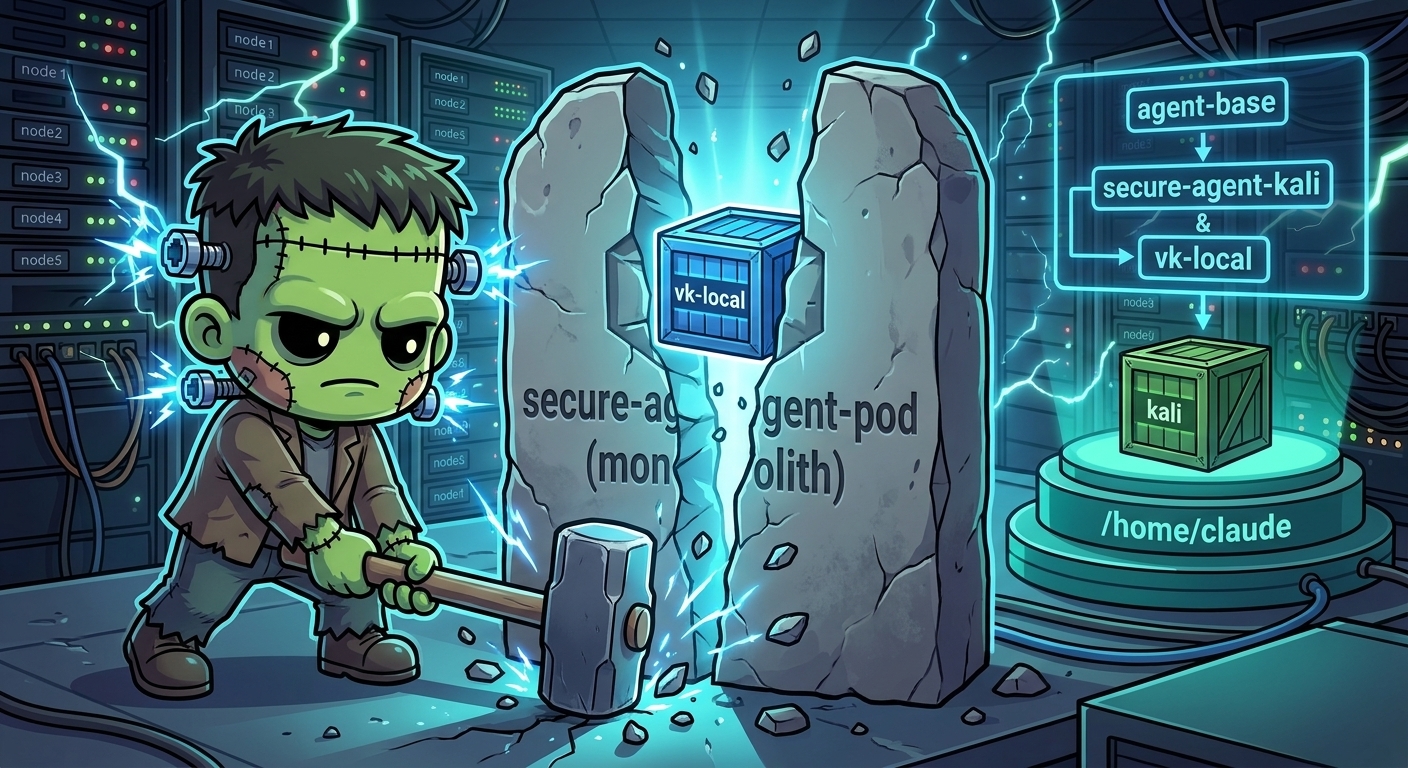
Agent Images and the VK-Local Sidecar — Unbaking VibeKanban
The secure-agent-pod started its life as a single container: Kali Linux, a non-root claude user, sshd, kubectl, and a globally npm install-ed VibeKanban baked straight into the image (layer 21, Secure Agent Pod). That worked. It also meant every VibeKanban bugfix required rebuilding a 1.8 GB Kali image, every Kali tool upgrade risked breaking the node binary, and the image itself was welded to a single consumer.
This post unbakes all of it.
The work splits into three moves:
- A new repo,
derio-net/agent-images, that publishes a sharedagent-baseand per-pod children (secure-agent-kali,vk-local) via matrix CI. - A sidecar in the pod: kali keeps everything it had except VibeKanban, and a second container runs a compiled-from-source VK server binary. They share
/home/claudeas a PVC. - A lockstep bumper in
frank: whenever any upstream image advances, a single PR opens updating all three references together.
Along the way, two gotchas that cost me an hour each: a port-8081 bind race where the old in-process VK won, and a Rust build script that silently embeds a placeholder HTML page when the frontend isn’t built.
Why split?
The fused pod violated a separation that I’d already established elsewhere on the cluster: where code runs is separate from how code is built. The pod is the runtime; the image is a build artifact; the Dockerfile belongs to whoever maintains the image. Packing Kali tools and a VibeKanban server into one Dockerfile made image updates atomic, but it also made them coupled — you couldn’t ship a VK patch without a Kali rebuild.
The second reason is re-use. The next secure-agent-<flavour> pod I wanted to build — a hardened Python data-science sandbox — would share 80% of its base with Kali. Claude Code, gh CLI, node, bun, uv, supercronic, the non-root user, the entrypoint scaffolding. Copy-pasting that into every pod’s Dockerfile is a promise to forget to update one of them.
A base image is the obvious fix. But a base image needs a home. frank already has too many responsibilities, and the GPU pod and agent pods aren’t really “cluster apps” in the sense that ArgoCD should manage their source. So a new repo gets to own it.
Architecture
derio-net/vibe-kanban          derio-net/agent-images              derio-net/frank

fork CI:                       matrix CI:                          bumper CI:
  build vk-remote       ┐       build agent-base                    on dispatch:
  build vk-build────────┼─COPY─► build secure-agent-kali             collect SHAs
                        │       build vk-local                       open 1 PR bumping
repository_dispatch─────┘       repository_dispatch───────────────►  vk-remote + vk-local
                                                                      + secure-agent-kali
                                                                     (ArgoCD syncs → bounce)
Three repos, three CI loops, two repository_dispatch hops. Any push to the fork eventually produces a reviewable PR in frank — no manual coordination, no Slack ping, no “remember to bump the tag”.
The new repo: agent-images
The repo is tiny:
agent-images/
├── .github/workflows/build.yaml
├── base/Dockerfile
├── kali/
│   ├── Dockerfile
│   ├── entrypoint.sh
│   └── assets/{sshd_config,crontab.txt}
└── vk-local/Dockerfile
base/Dockerfile is a FROM debian:bookworm-slim with every tool that every agent pod needs — Claude Code CLI, gh, node 22, bun, python3, uv, git, tini, supercronic, a non-root claude user (UID 1000 to match the PVC). About 40 lines.
Each child starts with FROM ghcr.io/derio-net/agent-base:${AGENT_BASE_SHA} and layers on what’s specific. kali/ adds the Kali archive, kali-tools-top10, nmap, netcat, kubectl/talosctl/omnictl, and sshd. vk-local/ adds nothing — it just COPY --from=vk-artifact /server /usr/local/bin/vibe-kanban from an upstream artifact image (more on that below) and sets EXPOSE 8081.
CI uses a matrix:
jobs:
  build-base:
    runs-on: ubuntu-latest
    outputs:
      sha: ${{ github.sha }}
    # ... build and push agent-base with cache-from/cache-to GHA cache

  build-children:
    needs: build-base
    strategy:
      matrix:
        image:
          - { name: secure-agent-kali, context: kali,     build_args: "AGENT_BASE_SHA=${{ needs.build-base.outputs.sha }}" }
          - { name: vk-local,          context: vk-local, build_args: "AGENT_BASE_SHA=${{ needs.build-base.outputs.sha }}\nVK_FORK_SHA=${{ github.event.client_payload.vk_fork_sha || 'latest' }}" }
    runs-on: ubuntu-latest
    # ... same build-push pattern, one per matrix entry
The needs: build-base dependency means children always inherit the just-built base SHA from the same commit. This guarantees a secure-agent-kali:<sha> and vk-local:<sha> were built against agent-base:<sha> with matching digests — no “last-night base image had different glibc” surprises.
Dispatch chains are simple:
  dispatch-frank:
    needs: build-children
    runs-on: ubuntu-latest
    steps:
      - run: gh api repos/derio-net/frank/dispatches -f event_type=agent-images-bumped -f client_payload[agent_images_sha]=${{ github.sha }}
        env: { GH_TOKEN: ${{ secrets.DISPATCH_PAT }} }
The fork artifact
VibeKanban is an npm-published binary, but secure-agent-kali previously installed it via npm install -g @vibe-kanban/cli. That worked but meant every upgrade had to re-download and re-pack node_modules into the image, and the whole thing had to be re-installed at pod bootstrap because the PVC mount at /home/claude hid the image-baked files.
The sidecar version runs the Rust server binary directly. To get that binary, derio-net/vibe-kanban (my fork) now publishes an artifact-only image whenever its main branch moves:
# BEGIN crates/server/Dockerfile (vibe-kanban fork)
FROM node:24-alpine AS fe-builder
WORKDIR /app
RUN corepack enable
COPY pnpm-lock.yaml pnpm-workspace.yaml package.json ./
COPY packages/{local-web,ui,web-core}/package.json packages/{local-web,ui,web-core}/
COPY patches/ patches/
RUN pnpm install --frozen-lockfile
COPY packages/ packages/
COPY shared/ shared/
RUN pnpm -C packages/local-web build

FROM rust:1.93-slim-bookworm AS builder
WORKDIR /build
RUN apt-get install -y pkg-config libssl-dev clang libclang-dev
COPY . .
COPY --from=fe-builder /app/packages/local-web/dist packages/local-web/dist
RUN cargo build --release --package server

FROM scratch
COPY --from=builder /build/target/release/server /server
That COPY --from=fe-builder ... line is not cosmetic. I’ll come back to that in the gotchas.
The published image is ghcr.io/derio-net/vibe-kanban-build:<fork-sha> — a FROM scratch image containing nothing but /server. The vk-local Dockerfile in agent-images pulls that file out:
ARG VK_FORK_SHA=latest
FROM ghcr.io/derio-net/vibe-kanban-build:${VK_FORK_SHA} AS vk-artifact
FROM ghcr.io/derio-net/agent-base:${AGENT_BASE_SHA}
COPY --from=vk-artifact /server /usr/local/bin/vibe-kanban(ARG in COPY --from=image:${ARG} doesn’t interpolate, so you need the named build stage trick.)
The sidecar in frank
The old deployment had one container. The new one has two:
spec:
  template:
    spec:
      containers:
        - name: kali
          image: ghcr.io/derio-net/secure-agent-kali:<sha>
          env:
            - { name: PORT, value: "18081" }       # dead config post-cutover
            - { name: HOST, value: "127.0.0.1" }   # see gotcha below
          volumeMounts:
            - { name: agent-home, mountPath: /home/claude }
        - name: vk-local
          image: ghcr.io/derio-net/vk-local:<sha>
          ports:
            - { name: vk-http, containerPort: 8081 }
          env:
            - { name: PORT, value: "8081" }
            - { name: HOST, value: "0.0.0.0" }
          volumeMounts:
            - { name: agent-home, mountPath: /home/claude }
          readinessProbe: { httpGet: { path: /api/health, port: vk-http } }
Both containers mount the same agent-home PVC at /home/claude. That’s the whole contract between them: kali does ad-hoc work (SSH sessions, Claude Code runs, git clones), and every file lands in a place vk-local can also see. There’s no IPC, no shared memory, no RPC — the filesystem is the interface.
The Service routes 8081 to the vk-http port, which is now on the sidecar. External consumers (vk.cluster.derio.net, http://192.168.55.218:8081) can’t tell the difference.
The lockstep bumper
When agent-images or vibe-kanban publishes a new image, frank needs to know. The bumper is one workflow that listens for repository_dispatch and opens a PR:
on:
  repository_dispatch:
    types: [agent-images-bumped]
  workflow_dispatch:
    inputs: { agent_images_sha: { required: true } }

jobs:
  bump:
    runs-on: ubuntu-latest
    permissions: { contents: write, pull-requests: write }
    steps:
      - uses: actions/checkout@v4
      - name: Resolve SHAs
        run: |
          AI_SHA="${{ github.event.client_payload.agent_images_sha || inputs.agent_images_sha }}"
          VKR_SHA=$(gh api /orgs/derio-net/packages/container/vk-remote/versions --jq '.[0].metadata.container.tags[] | select(test("^[a-f0-9]{7}$"))' | head -1)
          # ...
      - name: Update manifests
        run: |
          sed -i "s|secure-agent-kali:[a-f0-9]\+|secure-agent-kali:$AI_SHA|" apps/secure-agent-pod/manifests/deployment.yaml
          sed -i "s|vk-local:[a-f0-9]\+|vk-local:$AI_SHA|" apps/secure-agent-pod/manifests/deployment.yaml
          sed -i "s|vk-remote:[a-f0-9]\+|vk-remote:$VKR_SHA|" apps/vk-remote/manifests/deployment.yaml
      - name: Open PR
        run: |
          git config user.name "clawdia-bumper[bot]"
          git checkout -b "bump/agent-images-${AI_SHA:0:7}"
          if git diff --quiet; then echo "No diff" && exit 0; fi
          git commit -am "chore(agents): bump agent-images to ${AI_SHA:0:7}, vk-remote to ${VKR_SHA}"
          git push origin HEAD
          gh pr create --base main --title "chore(agents): bump agent-images + vk-remote" --body "..."
One push to the fork, one PR in frank. The human reviews a 6-line diff, clicks merge, and ArgoCD picks up the rest. No tag hunting, no manual sed, no accidentally bumping vk-local without bumping vk-remote and ending up with a version mismatch.
Gotcha 1: the port-8081 bind race
The plan said: “the lighter sidecar will win the 8081 bind race because the kali npm VK boots slower.” That plan assumed the universe is fair. It is not.
On every pod restart, kali’s supercronic bootstrap ran /home/claude/.local/bin/vibe-kanban start before the sidecar’s Rust binary had finished its cold start. Kali grabbed port 8081. The sidecar came up, tried to bind, failed with EADDRINUSE, and went into CrashLoopBackOff. 246 restarts in 20 hours.
The fix was mechanical — make the loser losable:
- name: kali
  env:
    - { name: PORT, value: "18081" }
    - { name: HOST, value: "127.0.0.1" }
Kali’s in-process VK now binds 127.0.0.1:18081, which no one routes to. The sidecar owns 0.0.0.0:8081 unopposed. Once the Task B rebuild strips VK from the kali image entirely, those env vars become dead config — I left them in place because the Task B diff had to be a single line, and the cleanup can come later.
The lesson: “shouldn’t happen” is not a design. Two processes racing for the same port is a bug even when you know which one will win. Make outcomes deterministic by structure, not by timing.
Gotcha 2: “Please build @vibe/local-web first”
After the sidecar cutover, vk-local responded on port 8081. /api/health returned 200. Everything looked good — until I opened the UI in a browser and saw:
<!DOCTYPE html>
<html><head><title>Build web app first</title></head>
<body><h1>Please build @vibe/local-web first</h1></body></html>
Five words, six hours of wondering if the React SPA was failing to hydrate. It wasn’t. The server was intentionally serving that HTML.
crates/server/src/routes/frontend.rs uses rust-embed:
#[derive(RustEmbed)]
#[folder = "../../packages/local-web/dist"]
struct FrontendAssets;
At compile time, every file in that directory gets compiled into the binary as a &[u8] constant. If the directory doesn’t exist? Well, rust-embed errors out — unless something else creates it first. And something else does:
// crates/server/build.rs
let dist_path = Path::new("../../packages/local-web/dist");
if !dist_path.exists() {
    fs::create_dir_all(dist_path).unwrap();
    fs::write(dist_path.join("index.html"),
              r#"<!DOCTYPE html>...<h1>Please build @vibe/local-web first</h1>..."#).unwrap();
}
The build script creates a dummy index.html with the placeholder. rust-embed happily embeds that. cargo build succeeds. The binary ships. The UI says what it says.
This is a friendly-looking footgun in a full-stack monorepo: a Rust build system that silently covers for a missing frontend build. The fix, as shown in the Dockerfile above, is to not miss the frontend build — the fe-builder stage runs pnpm -C packages/local-web build before the Rust stage, and the resulting dist/ gets COPY-ed into position before cargo build runs.
The lesson: if your build accepts a missing input with a warning, that warning needs to fail CI. A build that completes in a state the runtime can’t recover from is worse than a build that fails outright.
Verification
After all three PRs merged and ArgoCD synced:
$ kubectl -n secure-agent-pod get pod -l app=secure-agent-pod -o jsonpath='{range .items[0].spec.containers[*]}{.name}={.image}{"\n"}{end}'
kali=ghcr.io/derio-net/secure-agent-kali:95e364f81c392ae9ba2a5508d36897c399b2f037
vk-local=ghcr.io/derio-net/vk-local:95e364f81c392ae9ba2a5508d36897c399b2f037

$ kubectl -n secure-agent-pod exec deploy/secure-agent-pod -c kali -- command -v vibe-kanban || echo "VK GONE"
VK GONE

$ kubectl -n secure-agent-pod exec deploy/secure-agent-pod -c vk-local -- ls /home/claude/repos
agent-images  frank  secure-agent-kali  superpowers-for-vk  vibe-kanban

$ kubectl -n secure-agent-pod exec deploy/secure-agent-pod -c kali -- ls /home/claude/repos
agent-images  frank  secure-agent-kali  superpowers-for-vk  vibe-kanban

$ curl -sS http://192.168.55.218:8081/ | head -3
<!DOCTYPE html>
<html lang="en">
  <head>
$ kubectl -n secure-agent-pod get pod -l app=secure-agent-pod -o jsonpath='{range .items[0].spec.containers[*]}{.name}={.image}{"
"}{end}'
kali=ghcr.io/derio-net/secure-agent-kali:ef12b21c73d7f162d4f617eb863a8692c78ae31e
vk-local=ghcr.io/derio-net/vk-local:ef12b21c73d7f162d4f617eb863a8692c78ae31e
$ kubectl -n secure-agent-pod exec deploy/secure-agent-pod -c kali -- bash -c 'command -v vibe-kanban || echo VK GONE'
VK GONE
$ kubectl -n secure-agent-pod exec deploy/secure-agent-pod -c vk-local -- ls /home/claude/repos
agent-images
frank
superpowers-for-vk
vibe-kanban
willikins
... # other private/personal repos omitted
Both containers see the same repos directory. The kali container no longer has the VK binary. The sidecar serves the real React app. The shared volume is the interface; the pod is the runtime; the Dockerfiles live in a repo that has one job.
What’s next
The agent-images repo makes it trivial to add a third pod. The next one I’m planning is a Python data-science sandbox with pandas, DuckDB, polars, and a Jupyter Lab sidecar — same pattern, different tool surface. That repo already has the CI scaffolding, matrix build, dispatch chain, and version-pin discipline. Adding a new image is: write a Dockerfile, add a matrix entry, push. The bumper catches up on its own.
The frontend-embed gotcha also generalised into a .claude/rules/frank-gotchas.md entry. Next time a Rust monorepo has a build script that creates missing inputs, I’ll know to look for the placeholder before I debug the SPA.
References
agent-imagesrepo — github.com/derio-net/agent-images- VibeKanban fork (Dockerfile fix in PR #6) — github.com/derio-net/vibe-kanban
- Plan and deviation log —
docs/superpowers/plans/2026-04-15--agents--agent-images-and-vk-local-sidecar.md - Prior art, same layer — Secure Agent Pod, VK Remote Self-Host
rust-embed— github.com/pyrossh/rust-embed