Paperclip — An AI Agent Orchestrator on Frank
Layer 11 gave the cluster a Kubernetes-native agentic control plane: Sympozium, where agents are Pods, policies are CRDs, and the API server is the source of truth. It maps cleanly onto the mental model of someone who already lives in Kubernetes.
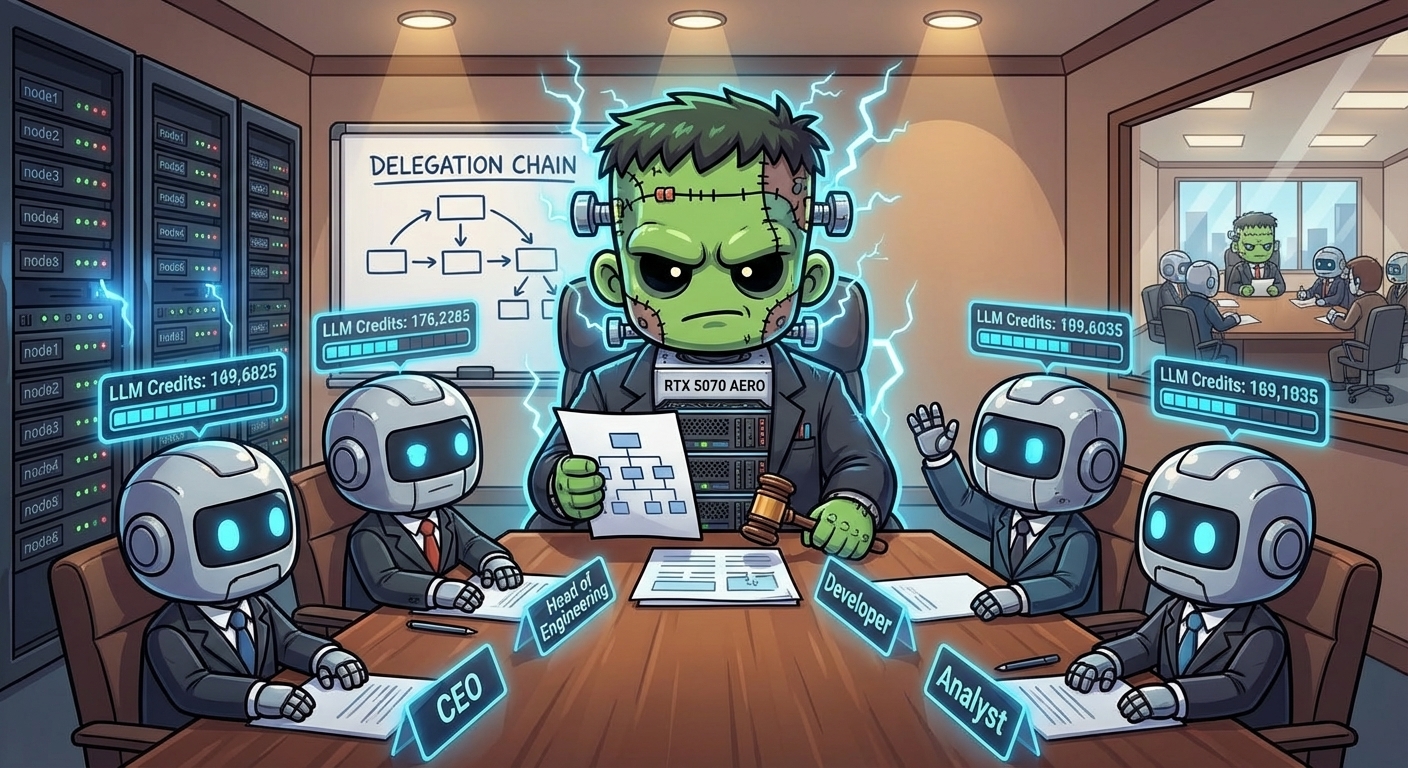
Layer 14 adds a second perspective. Paperclip organises agents differently — into virtual companies with org charts, budgets, reporting lines, and governance. Where Sympozium asks “which Kubernetes primitive models this agent?”, Paperclip asks “what role would this agent have in a company?”.
The goal is not to choose one over the other right now. Both run side by side. The cluster will make the comparison for me.
What Is Paperclip?
Paperclip is an open-source AI agent orchestrator. Its core abstraction is the company: a named organisation with a CEO agent, department heads, and individual contributor agents, each with a defined role, a tool set, and a budget for LLM calls. Agents collaborate through message passing and report up the chain of command.
The web UI — served on the same port as the API — lets you define the org chart, deploy the company, watch agents reason and delegate, and review execution traces.
Paperclip does not publish container images. The project ships a Dockerfile but leaves building to the operator. That made this layer slightly more involved than usual.
Architecture
paperclip-system
├── paperclip-db          (ArgoCD app, wave 0)
│   └── Bitnami PostgreSQL 14.1.10 — Longhorn 5Gi
└── paperclip             (ArgoCD app, wave 1)
    ├── Deployment         ghcr.io/derio-net/paperclip:v0.3.1
    ├── ExternalSecret     OPENAI_API_KEY + OPENAI_BASE_URL (LiteLLM)
    ├── ExternalSecret     BETTER_AUTH_SECRET
    ├── ExternalSecret     GHCR imagePullSecret
    ├── PVC                /paperclip data volume — Longhorn 2Gi
    └── Service (LB)       192.168.55.212:3100
Two ArgoCD apps, ordered by sync-wave. The database deploys first (wave 0); the application follows (wave 1) once PostgreSQL is healthy. Agents route through the existing LiteLLM gateway — same OPENAI_BASE_URL pattern as Sympozium.
Building the Container Image
Paperclip’s Dockerfile is straightforward Node.js — pnpm install, pnpm build, USER node. But the image is not small. It installs Claude Code, Codex, and opencode-ai globally as part of the agent tooling. The final image sits around 2GB.
git clone https://github.com/paperclipai/paperclip.git /tmp/paperclip
cd /tmp/paperclip && git checkout v0.3.1

docker buildx build \
  --platform linux/amd64 \
  -t ghcr.io/derio-net/paperclip:v0.3.1 \
  --push .
The first attempt pushed an arm64-only image — the build machine defaulted to its native architecture. Every node in the cluster’s worker pool (mini-1/2/3, gpu-1, pc-1) is amd64. The pod scheduled, pulled successfully, and immediately failed with no match for platform in manifest. A rebuild with --platform linux/amd64 fixed it.
The image lives in the derio-net org on GHCR, pulled via an imagePullSecret sourced from Infisical.
The PostgreSQL Mirror Problem
Bitnami no longer serves named image tags from Docker Hub. Any chart version older than a few months will point to a tag like bitnami/postgresql:16.2.0-debian-11-r16 that simply returns 404. This affects not just the main database image but also the metrics sidecar (bitnami/postgres-exporter).
The working solution — already established by the infisical-postgresql app — is to override the image registry to mirror.gcr.io/bitnamilegacy:
image:
  registry: mirror.gcr.io
  repository: bitnamilegacy/postgresql

metrics:
  enabled: true
  image:
    registry: mirror.gcr.io
    repository: bitnamilegacy/postgres-exporter
The GCR mirror carries all the legacy tags. Both images pull cleanly.
Probe Behaviour in Private Mode
Paperclip runs in authenticated mode with private exposure. In this configuration the root path / returns 403 to any request not coming from localhost. The kubelet issues readiness probes from the node IP — not from within the container — so httpGet probes against / or /api/health get 403 and the pod never becomes Ready.
From inside the container, /api/health returns 200. From the kubelet, it returns 403. The fix is a TCP socket probe: it checks that port 3100 is accepting connections without making an HTTP request at all.
readinessProbe:
  tcpSocket:
    port: http
  periodSeconds: 10
livenessProbe:
  tcpSocket:
    port: http
  initialDelaySeconds: 30
  periodSeconds: 15
The PVC Rollout Deadlock
The /paperclip data volume uses ReadWriteOnce — only one pod can hold the claim at a time. During rolling updates the Deployment creates the new pod before terminating the old one (the default RollingUpdate strategy). The new pod gets scheduled, tries to attach the PVC, and stalls with Multi-Attach error because the old pod still holds it.
Since the old pod was in CrashLoopBackOff it was never going to release the PVC gracefully. Each fix cycle added a new ReplicaSet, each new ReplicaSet created a new pod, and the PVC stayed locked.
The solution: scale the old ReplicaSet to zero manually to release the PVC, then let the new pod attach and start cleanly. Once the new pod passes its probe the Deployment controller cleans up the old RS on its own.
For a single-replica stateful app backed by ReadWriteOnce, a Recreate deployment strategy would avoid this entirely — kill the old pod first, then start the new one. Worth revisiting if this becomes a permanent fixture.
Volume Permissions
The Dockerfile does chown node:node /paperclip before USER node. When Longhorn mounts the PVC over /paperclip, the mounted directory is owned by root and the chown in the image never runs again. The node user (uid 1000, gid 1000) cannot write to it.
spec:
  securityContext:
    fsGroup: 1000
fsGroup tells Kubernetes to chown the mounted volume to gid 1000 before handing it to the container. With that in place, the node user can create /paperclip/instances/default/logs and everything else it needs.
Secret Management
Four ExternalSecrets sync from Infisical:
| Secret | Contains | How Used |
|---|---|---|
paperclip-llm-key | OPENAI_API_KEY + OPENAI_BASE_URL | envFrom — routes LLM calls through LiteLLM |
paperclip-auth | BETTER_AUTH_SECRET | envFrom — session signing |
paperclip-ghcr | .dockerconfigjson | imagePullSecrets — GHCR auth |
paperclip-anthropic | ANTHROPIC_API_KEY | envFrom — direct Anthropic access via claude_local adapter (optional) |
The paperclip-anthropic secret is marked optional: true in the Deployment — the pod starts normally without it. The claude_local adapter only needs it if you want to bypass LiteLLM and call Anthropic directly. Lesson learned: any secretRef for a feature that isn’t always provisioned should be optional: true, otherwise a missing Secret blocks rolling updates entirely (CreateContainerConfigError on the new pod, old pod stuck alive).
The LiteLLM secret uses the template merge pattern from Sympozium: a single Infisical key (PAPERCLIP_LITELLM_KEY) is combined with a static base URL at sync time, so the Deployment just does envFrom and gets both variables.
The database password follows the same pattern as all Bitnami chart deployments: the chart auto-generates a password and stores it in a <releaseName>-postgresql Secret. The Deployment reads it via secretKeyRef and builds the full DATABASE_URL using Kubernetes variable expansion:
env:
  - name: PG_PASSWORD
    valueFrom:
      secretKeyRef:
        name: paperclip-db-postgresql
        key: password
  - name: DATABASE_URL
    value: "postgres://paperclip:$(PG_PASSWORD)@paperclip-db-postgresql.paperclip-system.svc:5432/paperclip"
First Boot
Once the pod is 1/1 Running, open http://192.168.55.212:3100. Paperclip prompts for a bootstrap admin account. After that, pnpm paperclipai onboard (run inside the pod) generates the Agent JWT that unlocks full agent functionality.
The startup log is informative:
Server          3100
API             http://localhost:3100/api
UI              http://localhost:3100
Database        postgres://paperclip:***@paperclip-db-postgresql...
Migrations      applied (pending migrations)
Agent JWT       missing (run `pnpm paperclipai onboard`)
Heartbeat       enabled (30000ms)
DB Backup       enabled (every 60m, keep 30d)
Database migrations applied on first start. Automatic PostgreSQL backups to /paperclip/instances/default/data/backups every hour.
What’s Next
Paperclip and Sympozium now coexist on the same cluster, sharing the same LiteLLM gateway. The practical comparison will play out over the next few layers as I try to automate the same workflows through both and see which abstraction fits better.
Paperclip’s company/org-chart model might be better suited for long-running autonomous work with clear delegation chains. Sympozium’s CRD-native model fits better for workloads that need to interact with Kubernetes directly. Or they serve different purposes entirely and both stay.
The cluster will have opinions.