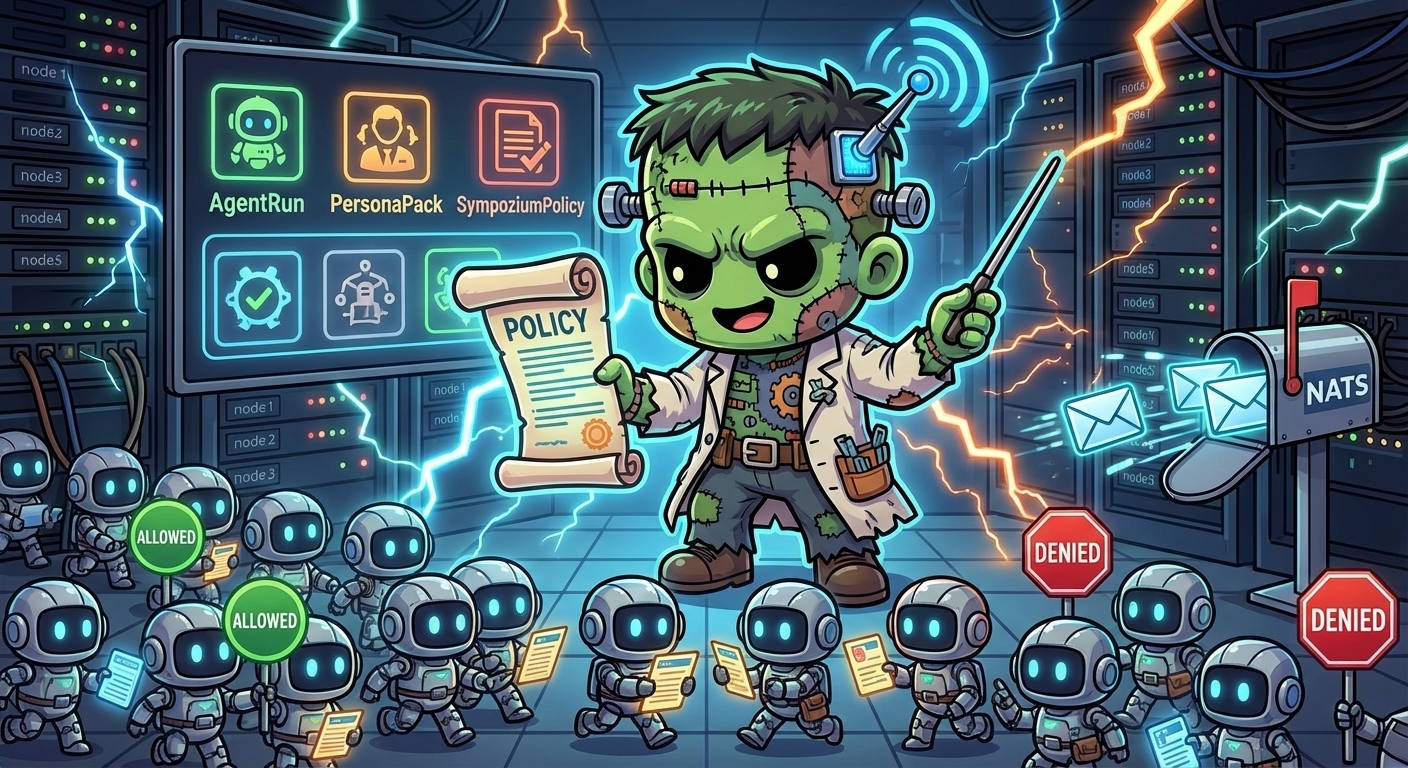
Agentic Control Plane — Sympozium
The cluster can serve models. Layer 10 wired up Ollama and LiteLLM so anything on the network can call an OpenAI-compatible endpoint. But models sitting behind an API are passive — they wait for requests and return responses. They don’t act.
Layer 11 adds the capability that makes them act. Sympozium is a Kubernetes-native agentic control plane. It turns the cluster into something that can reason, plan, and execute — autonomously, on a schedule, or on demand — all governed by Kubernetes-native policy.
Why Not Just Run Agents in Containers?
You could deploy an agent framework in a Deployment, give it a ServiceAccount, and let it call kubectl. That works for one agent. The moment you want multiple agents with different permissions, scheduled runs, policy enforcement, and audit trails, you are reinventing half of what Sympozium provides.
Sympozium maps agentic concepts to Kubernetes primitives:
| Agent Concept | Kubernetes Primitive |
|---|---|
| Agent identity | SympoziumInstance (CRD) |
| Execution | AgentRun (CRD) → Pod |
| Policy | SympoziumPolicy (CRD) |
| Skills | SkillPack (CRD) |
| Scheduling | SympoziumSchedule (CRD) |
| Persona bundle | PersonaPack (CRD) |
| Event bus | NATS JetStream (StatefulSet) |
Every agent run is an ephemeral Pod. When it finishes, the Pod exits. Kubernetes handles the lifecycle — retries, timeouts, resource limits. The controller watches AgentRun resources and reconciles them like any other operator.
The Architecture
Five components run in the sympozium-system namespace:
                            ┌─────────────────────┐
                            │   Web Dashboard     │
                            │  192.168.55.207:8080│
                            └────────┬────────────┘
                                     │
                            ┌────────▼────────────┐
                            │    API Server        │
                            │  (embedded web UI)   │
                            └────────┬────────────┘
                                     │
              ┌──────────────────────┼──────────────────────┐
              │                      │                      │
    ┌─────────▼──────────┐ ┌────────▼─────────┐ ┌─────────▼──────────┐
    │  Controller Manager │ │    Webhook       │ │  OTel Collector    │
    │  (reconcile loop)   │ │ (policy enforce) │ │  (observability)   │
    └─────────┬──────────┘ └──────────────────┘ └────────────────────┘
              │
    ┌─────────▼──────────┐
    │   NATS JetStream   │
    │  (durable events)  │
    └────────────────────┘
              │
    ┌─────────▼──────────┐
    │   Agent Pods        │
    │  (ephemeral Jobs)   │──── LiteLLM ──── Ollama / OpenRouter
    └────────────────────┘
Controller Manager watches for AgentRun CRs and spawns agent Pods. It manages the reconciliation loop — creating, monitoring, and cleaning up agent executions.
Webhook intercepts AgentRun creation and enforces SympoziumPolicies before admission. If a run violates a policy (wrong tools, too many sub-agents, sandbox required but not present), the webhook rejects it.
NATS JetStream is the internal event bus. Components communicate through durable streams — agent status updates, skill invocations, and inter-agent messages all flow through NATS. The StatefulSet uses a 1Gi Longhorn PVC for message persistence.
OTel Collector ships traces and metrics from agent runs to the cluster’s observability stack.
API Server serves the REST API and embeds the web dashboard.
PersonaPacks: Agent Bundles
Rather than configuring agents one by one, Sympozium uses PersonaPacks — CRDs that bundle a persona’s identity, policy, skills, and schedule into a single resource. When a PersonaPack is applied, the controller stamps out the individual SympoziumInstances, schedules, and configuration.
Three PersonaPacks are deployed:
Platform Team
| Persona | Policy | Schedule | Purpose |
|---|---|---|---|
sre-agent | default-policy | Hourly heartbeat | Cluster health checks, resource monitoring |
incident-responder | default-policy | On-demand | Event-triggered diagnostics |
The SRE agent runs every hour via a SympoziumSchedule. It uses the k8s-ops SkillPack to interact with the Kubernetes API — listing nodes, checking pod health, reading logs. The sre-watchdog persona also uses the llmfit SkillPack for hardware-aware model placement recommendations.
DevOps Essentials
| Persona | Policy | Schedule | Purpose |
|---|---|---|---|
code-reviewer | restrictive-policy | On-demand | Read-only code analysis |
The code reviewer has a deliberately constrained policy. It can read files and list directories but cannot write, execute commands, or fetch URLs. The restrictive policy enforces this at the webhook level.
Developer Team
The Sympozium chart ships with a built-in developer-team PersonaPack — a 2-pizza dev team of seven agents that collaborate on GitHub repositories:
| Persona | Schedule | Purpose |
|---|---|---|
tech-lead | 30m | PR review, issue triage, merge approved PRs |
backend-dev | 1h sweep | Pick up backend issues, implement, open PRs |
frontend-dev | 1h sweep | Pick up frontend/ui issues, implement, open PRs |
qa-engineer | 1h sweep | Test coverage gaps, bug discovery, edge cases |
code-reviewer | 30m sweep | Security/correctness/performance review of all PRs |
devops-engineer | 2h sweep | CI/CD health, Dockerfile updates, CVE patching |
docs-writer | 2h | Documentation drift detection, changelog updates |
We deploy a customised version in sympozium-extras rather than using the chart default — this adds authRefs (LiteLLM credentials), policyRef, model: qwen3.5, and homelab-appropriate schedule intervals (the built-in default is 5 minutes for all agents, which would saturate the RTX 5070).
Policy Enforcement
Policies are the key governance primitive. Each SympoziumPolicy CRD defines:
- Tool gating — which tools an agent can use (allow, deny, or ask-for-approval)
- Sub-agent limits — max depth and concurrency for agent-spawned sub-agents
- Sandbox requirements — whether agent Pods must run in a sandbox with CPU/memory limits
- Network policy — whether to deny all egress (with exceptions for DNS and the event bus)
- Feature gates — enable/disable capabilities like browser automation, code execution, file access
Two policy presets:
# default-policy — for trusted ops agents
toolGating:
  defaultAction: allow
  rules:
    - tool: execute_command
      action: ask        # human approval for shell commands
sandboxPolicy:
  required: false
networkPolicy:
  denyAll: false

# restrictive-policy — for dev-facing agents
toolGating:
  defaultAction: deny
  rules:
    - tool: read_file
      action: allow
    - tool: list_directory
      action: allow
    - tool: write_file
      action: deny
sandboxPolicy:
  required: true
  maxCPU: "2"
  maxMemory: 4Gi
networkPolicy:
  denyAll: true
The webhook enforces these at admission time. An AgentRun referencing a restrictive-policy persona that attempts to use write_file is rejected before the Pod ever starts.
LLM Routing Through LiteLLM
Agent Pods don’t talk directly to Ollama. They route through the LiteLLM gateway from Layer 10:
Agent Pod → LiteLLM (litellm.litellm.svc:4000) → Ollama / OpenRouterThis means agents automatically benefit from the full model roster — local models on the RTX 5070 and free cloud models via OpenRouter.
There is a subtlety here. The PersonaPack CRD has no baseURL field — generated SympoziumInstances don’t know where LiteLLM lives. Manually created instances can set spec.agents.default.baseURL, but PersonaPack-generated ones default to api.openai.com.
The fix exploits how the controller injects auth credentials. It uses envFrom with SecretRef — the entire Secret is projected as environment variables into the agent container. By adding OPENAI_BASE_URL alongside OPENAI_API_KEY in the auth secret, all agent pods automatically discover the LiteLLM endpoint:
apiVersion: external-secrets.io/v1
kind: ExternalSecret
metadata:
  name: sympozium-llm-key
  namespace: sympozium-system
spec:
  secretStoreRef:
    name: infisical
    kind: ClusterSecretStore
  target:
    name: sympozium-llm-key
    template:
      data:
        OPENAI_API_KEY: "{{ .OPENAI_API_KEY }}"
        OPENAI_BASE_URL: "http://litellm.litellm.svc:4000"
  data:
    - secretKey: OPENAI_API_KEY
      remoteRef:
        key: SYMPOZIUM_LITELLM_KEY
The ExternalSecret template merges the Infisical-sourced API key with a static base URL. No plaintext secrets in the repo — only the endpoint URL is hardcoded, and the actual key refreshes every 5 minutes from Infisical.
Deploying with ArgoCD
Three ArgoCD apps:
| App | Source | Purpose |
|---|---|---|
cert-manager | Helm (jetstack) | Webhook TLS certificates |
sympozium | Git (GitHub, chart path) | Core control plane |
sympozium-extras | Raw manifests | Policies, PersonaPacks, ExternalSecret, LB Service |
cert-manager
Sympozium’s webhook needs TLS certificates signed by a trusted CA. cert-manager handles the lifecycle — issuing, renewing, and injecting certificates into the webhook configuration.
# apps/root/templates/cert-manager.yaml
annotations:
  argocd.argoproj.io/sync-wave: "-1"  # Deploy before Sympozium
Sympozium Core
The Helm chart is sourced from Git — it is not published to any OCI or Helm registry:
sources:
  - repoURL: https://github.com/AlexsJones/sympozium.git
    targetRevision: v0.1.3
    path: charts/sympozium
One gotcha: the chart’s appVersion is 0.1.1 but v0.1.3 images include a critical webhook fix. Override the image tag explicitly:
# apps/sympozium/values.yaml
image:
  tag: v0.1.3
sympozium-extras
The chart’s built-in service template doesn’t support type or annotations overrides, so the LoadBalancer lives in a separate manifest:
# apps/sympozium-extras/manifests/service-lb.yaml
apiVersion: v1
kind: Service
metadata:
  name: sympozium-apiserver-lb
  namespace: sympozium-system
  annotations:
    lbipam.cilium.io/ips: "192.168.55.207"
spec:
  type: LoadBalancer
  selector:
    app.kubernetes.io/component: apiserver
  ports:
    - name: http
      port: 8080
      targetPort: http
Gotchas
Git-Sourced Helm Chart
The Sympozium chart is not published to an OCI or Helm registry. ArgoCD must use a Git source with path: charts/sympozium instead of chart:. This is the same pattern used for the vendored Intel GPU DRA driver chart.
Image Tag Override
The chart’s appVersion lags behind the latest tagged release. The v0.1.3 images fix a critical nil-pointer panic in the webhook’s PolicyEnforcer (the Decoder field was uninitialized). Without the override, agent creation is rejected with invalid memory address or nil pointer dereference.
Service Template Limitations
The chart’s apiserver deployment template hardcodes a ClusterIP service with no support for type or annotation overrides. Custom service configuration requires a separate manifest in extras.
PodSecurity and the llmfit SkillPack
The llmfit SkillPack injects sidecars that require hostPID: true and hostPath volumes for /proc, /sys, /dev, and /run/udev. Under the default baseline PodSecurity standard, the admission controller rejects these pods:
pods "frankie-heartbeat-5-zlxjf" is forbidden: violates PodSecurity
"baseline:latest": host namespaces (hostPID=true), hostPath volumes
Sympozium runs agent pods in the controller’s namespace — there is no agentNamespace configuration. The controller reads its namespace from the downward API and creates all Jobs there. A separate “agents” namespace would not help because the controller has no mechanism to redirect agent pods.
The fix is a declarative Namespace manifest in sympozium-extras that sets pod-security.kubernetes.io/enforce: privileged on sympozium-system. This allows llmfit-using agents to run while keeping the label under ArgoCD management.
PersonaPack baseURL Limitation
The PersonaPack CRD has no baseURL field at either the pack or persona level. When the controller stamps out SympoziumInstances from a PersonaPack, the generated instances lack baseURL and default to api.openai.com. Manually created SympoziumInstances (like frankie) can set spec.agents.default.baseURL directly, but PersonaPack-generated instances cannot.
The workaround is to inject OPENAI_BASE_URL into the auth secret (see LLM Routing above). The controller uses envFrom with SecretRef, so all keys in the secret become environment variables in agent pods.
CRD Discovery Timing
After initial deployment, sympozium-extras may fail to sync because ArgoCD hasn’t discovered the Sympozium CRDs yet. A manual sync of the root app followed by a retry resolves this.
What is Next
The control plane is running. Three PersonaPacks are deployed — platform-team, devops-essentials, and the 7-persona developer-team. The PodSecurity and LLM routing fixes unblock agent execution, so scheduled heartbeats and sweeps can now produce real results through the local inference stack on the RTX 5070.
Next steps: Telegram channel integration for mobile notifications, custom SkillPacks for cluster-specific operations, pointing the developer-team at a target repository, and connecting agent traces to the observability stack for closed-loop monitoring.